


Page 57 -
P. 57
Physics
            How are objects deformed?

            When an object is deformed, the position of its particles changes. If a body is compressed,
            the distance between its molecules decreases as the repulsive forces become greater than
            the attraction forces trying to return the molecules to their initial position. If molecules do
            return to their initial position, this deformation is called an elastic deformation. Elastic
            materials include rubber, steel, wood, cork and PVC (a common material widely used in
            every aspect of modern life).
                   textbooks nis edu kz
            Sometimes an object may not be able to return to its initial conditions, depending on
            the magnitude of forces acting on the body, the type of material and the new positions
            of particles. In this case, the material is said to have undergone a plastic deformation.
            Examples of plastic (malleable) materials include wet clay, dough, lead, plastic and melflex
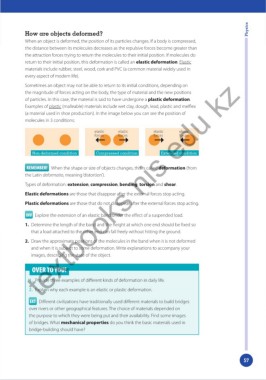
            (a material used in shoe production). In the image below you can see the position of
            molecules in 3 conditions:

                                            elastic    elastic         elastic     elastic
                                            forces     forces          forces      forces


                Non-deformed condition       Compressed condition          Extended condition


             REMEMBER!   When the shape or size of objects changes, this is called deformation (from
            the Latin deformatio, meaning ‘distortion’).

            Types of deformation: extension, compression, bending, torsion and shear.

            Elastic deformations are those that disappear after the external forces stop acting.
            Plastic deformations are those that do not disappear after the external forces stop acting.


             INV   Explore the extension of an elastic band under the effect of a suspended load.

            1.  Determine the length of the band and the height at which one end should be fixed so
               that a load attached to the other end can fall freely without hitting the ground.
            2.  Draw the approximate positions of the molecules in the band when it is not deformed
               and when it is subject to some deformation. Write explanations to accompany your
               images, describing the state of the object.


                OVER TO YOU!


              1.  Provide three examples of different kinds of deformation in daily life.
              2.  Explain why each example is an elastic or plastic deformation.


              EXT   Different civilizations have traditionally used different materials to build bridges
              over rivers or other geographical features. The choice of materials depended on
              the purpose to which they were being put and their availability. Find some images
              of bridges. What mechanical properties do you think the basic materials used in
              bridge-building should have?


                                                                                                                 57

