


Page 89 -
P. 89
Physics

            We know that to move faster you must apply more effort. The faster we move, the more
            friction force acts on us from our surroundings. Let us think of a vehicle. When it moves, the
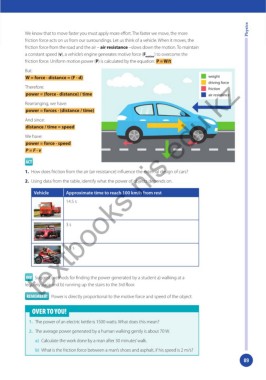
            friction force from the road and the air – air resistance –slows down the motion. To maintain
            a constant speed (v), a vehicle’s engine generates motive force (F  ) to overcome the
                                                                    motive
            friction force. Uniform motion power (P) is calculated by the equation:  P = W/t
            But:
                   textbooks nis edu kz
             W = force ∙ distance = (F ∙ d)                                                      weight
                                                                                                 driving force
            Therefore:                                                                           friction
             power = (force ∙ distance) / time                                                   air resistance

            Rearranging, we have:
             power = forces ∙ (distance / time)

            And since:
             distance / time = speed
            We have:
             power = force ∙ speed
             P = F ∙ v


             ACT
            1.  How does friction from the air (air resistance) influence the external design of cars?

            2.  Using data from the table, identify what the power of objects depends on.

                Vehicle        Approximate time to reach 100 km/h from rest

                               14.5 s


                               3 s


                               5.5 s


             INV   Suggest methods for finding the power generated by a student a) walking at a
            leisurely pace and b) running up the stairs to the 3rd floor.

             REMEMBER!   Power is directly proportional to the motive force and speed of the object.


                OVER TO YOU!

              1.  The power of an electric kettle is 1500 watts. What does this mean?

              2.  The average power generated by a human walking gently is about 70 W.

                 а)  Calculate the work done by a man after 30 minutes’ walk.

                 b)  What is the friction force between a man’s shoes and asphalt, if his speed is 2 m/s?
                                                                                                                 89

