


Page 5 -
P. 5
1.    Physical quantities and


                    measurements
                                                                Now you’ve studied the Grade 6
                                                                ‘Introduction to Science’
                                                                unit, you are able to:
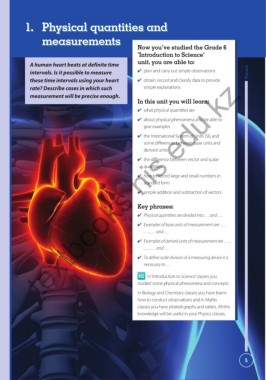
               STQuman heart beats at definite time
               A h
               intervals. Is it possible to measure             ✔  plan and carry out simple observations          Physics
                   textbooks nis edu kz
               these time intervals using your heart            ✔  obtain, record and classify data to provide
               rate? Describe cases in which such                  simple explanations
               measurement will be precise enough.
                                                                In this unit you will learn:

                                                                ✔  what physical quantities are
                                                                ✔  about physical phenomena and be able to
                                                                   give examples

                                                                ✔  the International System of Units (SI), and
                                                                   some differences between base units and
                                                                   derived units

                                                                ✔  the difference between vector and scalar
                                                                   quantities

                                                                ✔  how to record large and small numbers in
                                                                   standard form
                                                                ✔  simple addition and subtraction of vectors


                                                                Key phrases:

                                                                ✔  Physical quantities are divided into … and …

                                                                ✔  Examples of base units of measurement are … ,
                                                                   … , … and …
                                                                ✔  Examples of derived units of measurement are … ,
                                                                   … , … and …

                                                                ✔  To define scale division of a measuring device it is
                                                                   necessary to …

                                                                CCL   In ‘Introduction to Science’ classes you
                                                                studied some physical phenomena and concepts.

                                                                In Biology and Chemistry classes you have learnt
                                                                how to conduct observations and in Maths
                                                                classes you have plotted graphs and tables. All this
                                                                knowledge will be useful in your Physics classes.


                                                                                                                 5

