


Page 46 -
P. 46
5.1   Inertia


                 Why do we fasten our           Mass and inertia
                 seat belts and ensure          Physical bodies/objects have a tendency to remain in their state of motion.
                 children are secured           If an object is not moving, it tends to stay still. If an object is moving, it

                 in a safety seat when          tends to keep on moving, unless an external force is exerted on it.
                   textbooks nis edu kz
                 travelling in a car?           This idea of objects not changing in their state of motion is described as
                                                inertia. Of course, the inertia of different objects will be dependent on
                                                how heavy an object is (its mass), as we learnt in Unit 4.


                                                INV  Investigate the effect of forces on objects of different masses.
                                                Measure the mass of different objects and then use a newton meter
                                                (spring scale) to measure the force needed to pull the object along a
                                                surface. Can you identify any pattern in your results?

                                                Inertia and the change of speed

                                                The interaction of forces with objects can cause the speed of the
                                                object to change, the direction of motion to change or deformation
                                                of this object. If two objects interact with each other, the change in their
                                                speed and direction will depend on their masses.

                                                The heavier an object is, the less speed it gains (and the object is said to
                                                have more inertia). The lighter an object is, the greater the speed it gains
                                                (and the object is said to have less inertia). Bullets and shells have less
                                                inertia than rifles and cannons.
                                                If objects have the same speed after an interaction, it means their masses
                                                are equal. If objects have different speeds after an interaction, it means their
                                                masses are different. By comparing the speeds of two interacting objects
                                                we can determine the masses of objects that cannot be measured.


                                                                                      OVER TO YOU!


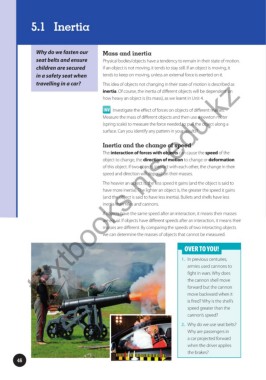
                                                                                    1.  In previous centuries,
                                                                                       armies used cannons to
                                                                                       fight in wars. Why does
                                                                                       the cannon shell move
                                                                                       forward but the cannon
                                                                                       move backward when it
                                                                                       is fired? Why is the shell’s
                                                                                       speed greater than the
                                                                                       cannon’s speed?
                                                                                    2.  Why do we use seat belts?
                                                                                       Why are passengers in
                                                                                       a car projected forward
                                                                                       when the driver applies
                                                                                       the brakes?
         46

