


Page 48 -
P. 48
5.2   Moving objects


                 What can forces do?            In daily life we often use the following words: force, strong, effort.
                                                When we say that someone exerts a greater force than someone else,
                                                we mean that person can, for example, push a car stuck in mud to
                                                release it, or lift a heavy suitcase. To do this the person needs to flex
                   textbooks nis edu kz
                                                his/her muscles and apply force. What is force? To what effect does the
                                                action of force lead?

                                                In both these examples there is some force acting on objects that
                                                causes a change of speed. When experiencing the effect of a force, an
                                                object can:

                                                ●  start its motion – speed up  ●  change the direction of motion
                                                ●  stop – slow down             ●  become deformed


                                                In nature, a variety of forces can act on an object, including:

                                                a)  gravitational force         d)  electric force
                                                b)  elastic force               e)  magnetic force

                                                c)  frictional force

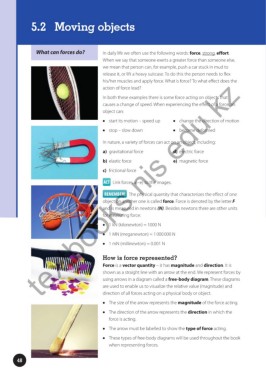
                                                ACT  Link forces a)–e) to the images.


                                                 REMEMBER!   The physical quantity that characterizes the effect of one
                                                object on another one is called force. Force is denoted by the letter F
                                                and is measured in newtons (N). Besides newtons there are other units
                                                for measuring force:

                                                ●  1 kN (kilonewton) = 1000 N
                                                ●  1 MN (meganewton) = 1 000 000 N

                                                ●  1 mN (millinewton) = 0.001 N


                                                How is force represented?
                                                Force is a vector quantity – it has magnitude and direction. It is
                                                shown as a straight line with an arrow at the end. We represent forces by
                                                using arrows in a diagram called a free-body diagram. These diagrams
                                                are used to enable us to visualize the relative value (magnitude) and
                                                direction of all forces acting on a physical body or object.

                                                ●  The size of the arrow represents the magnitude of the force acting.

                                                ●  The direction of the arrow represents the direction in which the
                                                   force is acting.
                                                ●  The arrow must be labelled to show the type of force acting.

                                                ●  These types of free-body diagrams will be used throughout the book
                                                   when representing forces.


         48

