


Page 49 -
P. 49
Physics

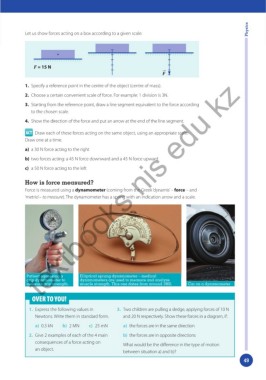
            Let us show forces acting on a box according to a given scale:


                   = 15 N


                   textbooks nis edu kz
            1.  Specify a reference point in the centre of the object (centre of mass).
            2.  Choose a certain convenient scale of force. For example: 1 division is 3N.

            3.  Starting from the reference point, draw a line segment equivalent to the force according
               to the chosen scale.

            4.  Show the direction of the force and put an arrow at the end of the line segment.

             ACT  Draw each of these forces acting on the same object, using an appropriate scale.
            Draw one at a time.

            a)  a 30 N force acting to the right

            b)  two forces acting: a 45 N force downward and a 45 N force upward
            c)  a 50 N force acting to the left


            How is force measured?

            Force is measured using a dynamometer (coming from the Greek ‘dynamis’ – force – and
            ‘metrio’– to measure). The dynamometer has a spring with an indication arrow and a scale.


             Patient squeezing a      Elliptical sprung dynamometer – medical
             grip dynamometer to      dynamometers are used to measure and analyze
             measure grip strength.   muscle strength. This one dates from around 1900.  Car on a dynamometer

                OVER TO YOU!


              1.  Express the following values in      3.  Two children are pulling a sledge, applying forces of 10 N
                 Newtons. Write them in standard form.   and 20 N respectively. Show these forces in a diagram, if:
                 a)  0.3 kN    b)  2 MN    c)  25 mN     a)  the forces are in the same direction

              2.  Give 2 examples of each of the 4 main   b)  the forces are in opposite directions
                 consequences of a force acting on        What would be the difference in the type of motion
                 an object.
                                                         between situation a) and b)?
                                                                                                                 49

