


Page 70 -
P. 70
7.3   The resultant force


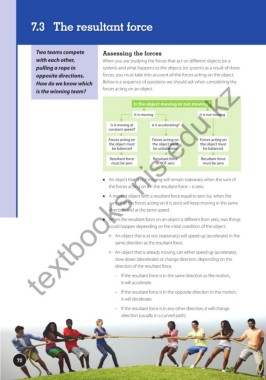
                 Two teams compete              Assessing the forces
                 with each other,               When you are studying the forces that act on different objects (or a
                 pulling a rope in              system) and what happens to the objects (or system) as a result of these

                 opposite directions.           forces, you must take into account all the forces acting on the object.
                                                                         is NOT zeroedu kz
                 How do we know which           Below is a sequence of questions we should ask when considering the
                                                forces acting on an object.
                 is the winning team?

                                                              Is the object moving or not moving?

                                                               It is moving                  It is not moving

                                                    Is it moving at    Is it accelerating?
                                                   constant speed?

                                                   Forces acting on    Forces acting on      Forces acting on
                   textbooks nis
                                                   the object must     the object must       the object must
                                                    be balanced        be unbalanced          be balanced

                                                   Resultant force     Resultant force       Resultant force
                                                    must be zero                              must be zero


                                                ●  An object that is not moving will remain stationary when the sum of
                                                   the forces acting on it – the resultant force – is zero.
                                                ●  A moving object with a resultant force equal to zero (i.e. when the
                                                   sum of all the forces acting on it is zero) will keep moving in the same
                                                   direction and at the same speed.

                                                ●  When the resultant force on an object is different from zero, two things
                                                   could happen depending on the initial condition of the object:

                                                      An object that is at rest (stationary) will speed up (accelerate) in the
                                                      same direction as the resultant force.

                                                      An object that is already moving can either speed up (accelerate),
                                                      slow down (decelerate) or change direction, depending on the
                                                      direction of the resultant force.
                                                      –  If the resultant force is in the same direction as the motion,
                                                         it will accelerate.

                                                      –  If the resultant force is in the opposite direction to the motion,
                                                         it will decelerate.

                                                      –  If the resultant force is in any other direction, it will change
                                                         direction (usually in a curved path).


         70

