


Page 71 -
P. 71
Physics

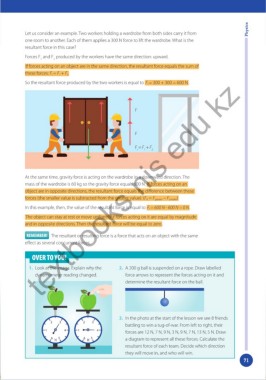
            Let us consider an example. Two workers holding a wardrobe from both sides carry it from
            one room to another. Each of them applies a 300 N force to lift the wardrobe. What is the
            resultant force in this case?
            Forces F  and F  produced by the workers have the same direction: upward.
                   1     2
             If forces acting on an object are in the same direction, the resultant force equals the sum of
            these forces: F r  = F 1  + F 2
                   textbooks nis edu kz
            So the resultant force produced by the two workers is equal to  F r  = 300 + 300 = 600 N .


                                                               F


                                                               F

                                                               F = F + F
                                                                r   1   2


            At the same time, gravity force is acting on the wardrobe in a downward direction. The
            mass of the wardrobe is 60 kg so the gravity force equals 600 N.  If forces acting on an
            object are in opposite directions, the resultant force equals the difference between these
            forces (the smaller value is subtracted from the greater value): (F R  = F greater  – F smaller )

            In this example, then, the value of the resultant force is equal to  F r  = 600 N - 600 N = 0 N .
             The object can stay at rest or move uniformly if forces acting on it are equal by magnitude
            and in opposite directions. Then the resultant force will be equal to zero .


             REMEMBER!   The resultant or resulting force is a force that acts on an object with the same
            effect as several concurrent forces.

                OVER TO YOU!


              1.  Look at the image. Explain why the    2.  A 200 g ball is suspended on a rope. Draw labelled
                 dynamometer reading changed.             force arrows to represent the forces acting on it and
                                                          determine the resultant force on the ball.


                                                        3.  In the photo at the start of the lesson we see 8 friends
                        2   3          2   3
                                                          battling to win a tug-of-war. From left to right, their
                      1       4      1       4
                                                          forces are 12 N, 7 N, 9 N, 3 N, 9 N, 7 N, 13 N, 5 N. Draw
                        6   5          6   5              a diagram to represent all these forces. Calculate the
                          H              H
                                                          resultant force of each team. Decide which direction
                                                          they will move in, and who will win.
                                                                                                                 71

