


Page 80 -
P. 80
8.3   Buoyancy: Archimedes’ Principle


                 People have sailed on          Upthrust force
                 rafts, boats and ships         There is a pressure in liquid that differs depending
                 since ancient times.           on the depth. As a result, any object immersed in

                 Such vessels used to           liquid experiences a force trying to push this object
                   textbooks nis edu kz
                 be made of wood but            out – the upthrust force.
                 nowadays passenger             Archimedes was the ancient Greek scientist

                 and cargo ships for            who discovered the force of buoyancy and first   Archimedes
                 rivers and seas are            calculated its magnitude.                        (287–212 bce)
                 built using different          EXT   Imagine you are a scientist and inventor. Write an article for a
                 materials. Yet they all        scientific magazine about the technical inventions of Archimedes.
                 float. Why does a heavy
                                                Upthrust force is calculated using this equation:
                 ship not sink but a light
                                                 Upthrust (Archimedes’) force = density of liquid × acceleration of
                 stone thrown into the
                                                gravity × volume of object immersed in liquid
                 water go straight down

                 to the bottom?                 F A  =    l      ob
                                                 g = 9.8 N/kg

                                                Archimedes’ Principle
                             F A
                                                When a load is immersed in water
                                                in a container, it displaces (pushes
                             F T
                                                out) some of the water, as shown
                                                in the image. The weight of this
                                                water equals the Archimedes’
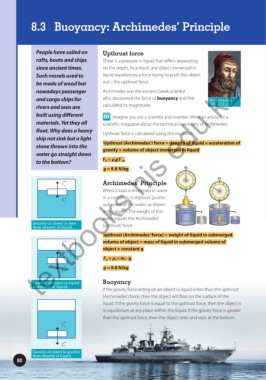
                Density of object is less
                than density of liquid.         (upthrust) force.
                                                 upthrust (Archimedes’ force) = weight of liquid in submerged
                                                volume of object = mass of liquid in submerged volume of
                             F A
                                                object × constant g

                                                 F A  =    l  = m l  ∙ g
                                                 g = 9.8 N/kg
                             F T

                Density of object is equal      Buoyancy
                to density of liquid.
                                                If the gravity force acting on an object in liquid is less than the upthrust
                                                (Archimedes’) force, then the object will float on the surface of the
                                                liquid. If the gravity force is equal to the upthrust force, then the object is
                                                in equilibrium at any place within this liquid. If the gravity force is greater
                                                than the upthrust force, then the object sinks and rests at the bottom.

                             F A


                             F T
                Density of object is greater
                than density of liquid.
         80

