


Page 76 -
P. 76
8.1   Pressure of solids


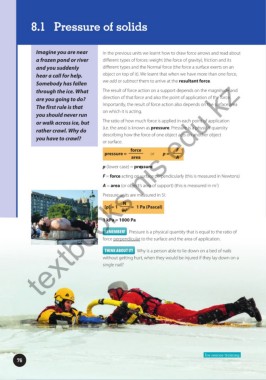
                 Imagine you are near           In the previous units we learnt how to draw force arrows and read about
                 a frozen pond or river         different types of forces: weight (the force of gravity), friction and its
                 and you suddenly               different types and the Normal force (the force a surface exerts on an

                 hear a call for help.          object on top of it). We learnt that when we have more than one force,
                   textbooks nis edu kz
                                                we add or subtract them to arrive at the resultant force.
                 Somebody has fallen
                 through the ice. What          The result of force action on a support depends on the magnitude and

                 are you going to do?           direction of that force and also the point of application of the force.
                                                Importantly, the result of force action also depends on the surface area
                 The first rule is that
                                                on which it is acting.
                 you should never run
                 or walk across ice, but        The ratio of how much force is applied in each point of application
                                                (i.e. the area) is known as pressure. Pressure is a physical quantity
                 rather crawl. Why do
                                                describing how the force of one object acts on another object
                 you have to crawl?
                                                or surface.
                                                             force                F
                                                 pressure =           or    p =
                                                             area                 A

                                                p (lower case) = pressure

                                                F = force acting on surface perpendicularly (this is measured in Newtons)
                                                                                                    2
                                                A = area (or object’s area of support) (this is measured in m )
                                                Pressure units are measured in SI:

                                                         N
                                                 [p] = 1     = 1 Pa (Pascal)
                                                         m 2
                                                1 kPa = 1000 Pa


                                                 REMEMBER!   Pressure is a physical quantity that is equal to the ratio of
                                                force perpendicular to the surface and the area of application.

                                                 THINK ABOUT IT!   Why is a person able to lie down on a bed of nails
                                                without getting hurt, when they would be injured if they lay down on a
                                                single nail?


                                                                                               Ice rescue training
         76

