


Page 81 -
P. 81
Physics
            Aerostatics

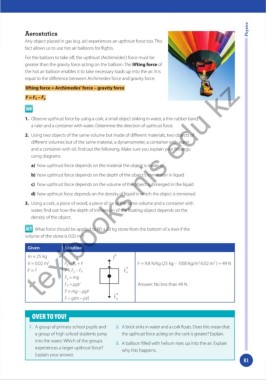
            Any object placed in gas (e.g. air) experiences an upthrust force too. This
            fact allows us to use hot air balloons for flights.

            For the balloon to take off, the upthrust (Archimedes’) force must be
            greater than the gravity force acting on the balloon. The lifting force of
            the hot air balloon enables it to take necessary loads up into the air. It is
                   textbooks nis edu kz
            equal to the difference between Archimedes’ force and gravity force:
             lifting force = Archimedes’ force – gravity force

             F = F A  – F g

             INV

            1.  Observe upthrust force by using a cork, a small object sinking in water, a thin rubber band,
               a ruler and a container with water. Determine the direction of upthrust force.

            2.  Using two objects of the same volume but made of different materials, two objects of
               different volumes but of the same material, a dynamometer, a container with water
               and a container with oil, find out the following. Make sure you explain your findings,
               using diagrams.

               a)  how upthrust force depends on the material the object is made of
               b)  how upthrust force depends on the depth of the object’s immersion in liquid

               c)  how upthrust force depends on the volume of the object submerged in the liquid

               d)  how upthrust force depends on the density of liquid in which the object is immersed
            3.  Using a cork, a piece of wood, a piece of ice of the same volume and a container with
               water, find out how the depth of immersion of the floating object depends on the
               density of the object.


             ACT  What force should be applied to lift a 20 kg stone from the bottom of a river if the
                                      3
            volume of the stone is 0.02 m ?
              Given            Solution

              m = 25 kg                              F
              V = 0.02 m 3     F g  = F A  + F                  F = 9.8 N/kg (25 kg – 1000 kg/m ·0.02 m  ) = 49 N
                                                                                                   3
                                                                                            3
              F = ?            F = F g  – F A             F A
                               F g  = mg
                               F A  = ρgV                       Answer: No less than 49 N.
                               F = mg – ρgV
                               F = g(m – ρV)         F g


                OVER TO YOU!

              1.  A group of primary school pupils and   2.  A brick sinks in water and a cork floats. Does this mean that
                 a group of high school students jump    the upthrust force acting on the cork is greater? Explain.
                 into the water. Which of the groups
                                                      3.  A balloon filled with helium rises up into the air. Explain
                 experiences a larger upthrust force?
                                                         why this happens.
                 Explain your answer.
                                                                                                                 81

