


Page 100 -
P. 100
10.3   Kinetic and potential energy


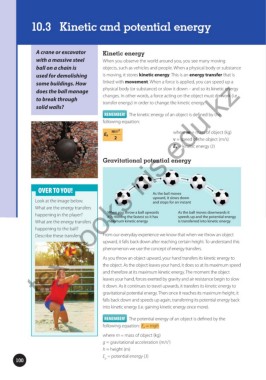
                 A crane or excavator           Kinetic energy
                 with a massive steel           When you observe the world around you, you see many moving
                 ball on a chain is             objects, such as vehicles and people. When a physical body or substance

                 used for demolishing           is moving, it stores kinetic energy. This is an energy transfer that is
                   textbooks nis edu kz
                 some buildings. How            linked with movement. When a force is applied, you can speed up a
                                                physical body (or substance) or slow it down – and so its kinetic energy
                 does the ball manage
                                                changes. In other words, a force acting on the object must do work (i.e.
                 to break through
                                                transfer energy) in order to change the kinetic energy.
                 solid walls?
                                                 REMEMBER!   The kinetic energy of an object is defined by the
                                                following equation:

                                                       2
                                                      v                         where    = mass of object (kg)
                                                 E K
                                                     2                          v = speed of the object (m/s)
                                                                                E K  = kinetic energy (J)


                                                Gravitational potential energy


                  OVER TO YOU!                                         As the ball moves

                                                                       upward, it slows down
                 Look at the image below.                              and stops for an instant
                 What are the energy transfers
                                                  When you throw a ball upwards    As the ball moves downwards it
                 happening in the player?         it is moving the fastest so it has   speeds up and the potential energy
                 What are the energy transfers    maximum kinetic energy           is transferred into kinetic energy
                 happening to the ball?
                 Describe these transfers.      From our everyday experience we know that when we throw an object
                                                upward, it falls back down after reaching certain height. To understand this
                                                phenomenon we use the concept of energy transfers.

                                                As you throw an object upward, your hand transfers its kinetic energy to
                                                the object. As the object leaves your hand, it does so at its maximum speed
                                                and therefore at its maximum kinetic energy. The moment the object
                                                leaves your hand, forces exerted by gravity and air resistance begin to slow
                                                it down. As it continues to travel upwards, it transfers its kinetic energy to
                                                gravitational potential energy. Then once it reaches its maximum height, it
                                                falls back down and speeds up again, transferring its potential energy back
                                                into kinetic energy (i.e. gaining kinetic energy once more).

                                                 REMEMBER!   The potential energy of an object is defined by the
                                                following equation:  E p  = mgh

                                                where m = mass of object (kg)
                                                                              2
                                                g = gravitational acceleration (m/s )
                                                h = height (m)
                                                E  = potential energy (J)
        100                                      p

