


Page 99 -
P. 99
Physics

            The efficiency of a device’s work is expressed as the ratio of the useful energy output of a
            device to the total energy input in the system:

                         output of useful energy
             Efficiency  =                     x 100%
                            total energy input
            Since power is the rate of energy transfer, it is also possible to calculate the efficiency using
            the ratio of the useful power to the power consumed:
                   textbooks nis edu kz
                         output of useful power
             Efficiency  =                     x 100%
                             supplied power

             ACT  A kettle transfers about 120 000 joules of electrical energy to its heating coil in about
            60 seconds. When heating 200 ml of water to 100 degrees Celsius, only about 70 000 J are
            transferred as thermal energy (heat) to the water. What is the efficiency of the kettle?


              Given                  SI         Solution
              Energy transferred to                         output of useful energy
                                                Efficiency =                        x 100%
              the water = 70 000 J   J (joules)             total energy consumed

              Total energy input in                        70 000 J
              60 seconds = 120 000 J  J (joules)  Efficiency =  120 000 J  x 100% = 58.3% → 60%
              Efficiency = ?

                                                Answer: Efficiency = 60%


             ACT  Let’s think about light bulbs again. In the case of a filament bulb, 120 J of electric
            energy is transferred as 100 J of thermal energy (heat) and 20 J of light energy. For an
            energy-saving bulb, 120 J of electric energy is spent on 10 J “lost” energy (heat), while 110 J
            is light energy. Draw a labelled Sankey diagram to scale, and calculate the efficiency of each
            light bulb.

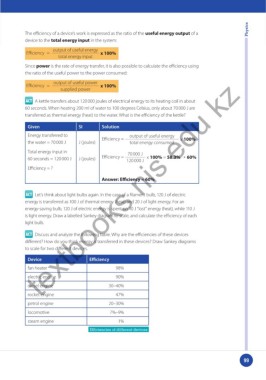
             ACT  Discuss and analyze the following table. Why are the efficiencies of these devices
            different? How do you think energy is transferred in these devices? Draw Sankey diagrams
            to scale for two different devices.


              Device                      Efficiency
              fan heater                              98%
              electric engine                         90%

              diesel engine                        30–40%

              rocket engine                           47%
              petrol engine                        20–30%

              locomotive                           7%–9%
              steam engine                             1%

                                          Efficiencies of different devices


                                                                                                                 99

