


Page 98 -
P. 98
10.2   Transferring energy


                 The manufacture of             Transferring stored energy
                 filament light bulbs           The chemical energy stored in the form of fossil fuels such as oil, gas
                 has stopped around             and coal is transferred as heat and light through combustion. In a power

                 the world, including           station, this is transferred by means of heating water and generating
                   textbooks nis edu kz
                 in Kazakhstan. Why             steam. This steam puts generators (devices that generate electricity)
                                                into action. Generators produce electricity which is then transferred
                 do you think this
                                                to devices across the country. Another part of chemical energy is
                 has happened?
                                                transferred to the environment by means of heating materials and air in
                                                power stations and powering the work of household devices (a lamp, for
                                                example). This energy cannot be restored: we say ‘energy was transferred
                                                to the surroundings’. Energy is constantly being transferred.
                                                Let us consider another example. A car needs fuel to start moving.
                                                Burning fuel generates a large quantity of heat energy, which powers
                                                the engine. This also increases the temperature of the surroundings.

                                                Other examples include the electric kettle, which transmits heat to the
                                                environment as it heats up, or the friction generated between parts
                                                of a working mechanism. Of course, friction can be reduced using oil
                                                or lubricant, but it is impossible to remove it completely. Sometimes
                                                friction causes excessive heat, and this also leads to energy being
                                                transferred to non-useful energy.


                                                Efficiency of energy transfers
                                                The main issue regarding energy transfers is that of efficiency. This
                                                concept relates to how much energy needs to be transferred for a
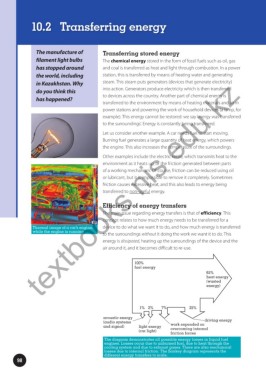
                Thermal image of a car’s engine,   device to do what we want it to do, and how much energy is transferred
                while the engine is running
                                                to the surroundings without it doing the work we want it to do. This
                                                energy is dissipated, heating up the surroundings of the device and the
                                                air around it, and it becomes difficult to re-use.


                                                               100%
                                                               fuel energy
                                                                                                65%
                                                                                                heat energy
                                                                                                (wasted
                                                                                                energy)


                                                                 1%  2%    7%           25%

                                                acoustic energy
                                                (audio systems                                 driving energy
                                                and signal)      light energy   work expended on
                                                                 (car light)   overcoming internal
                                                                               friction forces
                                                 The diagram demonstrates all possible energy losses in liquid fuel
                                                 engines. Losses occur due to unburned fuel, due to heat through the
                                                 cooling system and due to exhaust gases. There are also mechanical
                                                 losses due to internal friction. The Sankey diagram represents the
                                                 different energy transfers to scale.
         98

