


Page 102 -
P. 102
Unit summary


               Check your knowledge and understanding

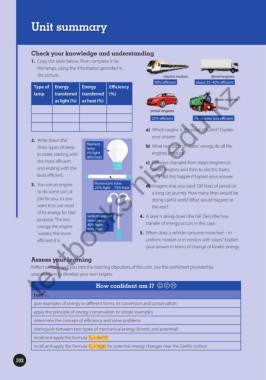
               1.  Copy the table below. Then complete it for
                  the lamps, using the information provided in
                  the picture.                                              electric motors       diesel engines
                   textbooks nis edu kz
                                                                        90% efficient      about 35–40% efficient
                Type of   Energy       Energy      Efficiency
                lamp      transferred  transferred  (%)
                          as light (%)  as heat (%)                                                steam engines

                                                                      petrol engines
                                                                       25% efficient      7% or even less efficient

                                                                    a)  Which engine is the most efficient? Explain
                                                                       your answer.
               2.  Write down the
                                         filament
                  three types of lamp    lamp                       b)  What two sorts of ‘waste’ energy do all the
                  in order, starting with   4% light                   engines produce?
                                         96% heat
                  the most efficient                                c)  Railways changed from steam engines to
                  and ending with the                                  diesel engines and then to electric trains.
                  least efficient.                                     Why did this happen? Explain your answer.

               3.  You use an engine        fluorescent tube        d)  Imagine that you used 100 litres of petrol on
                                            25% light  75% heat
                  to do some sort of                                   a long car journey. How many litres would be
                  job for you, so you                                  doing useful work? What would happen to
                  want it to use most                                  the rest?
                  of its energy for that
                                         sodium vapour           4.  A skier is skiing down the hill. Describe how
                  purpose. The less      street lamp
                  energy the engine      40% light                  transfer of energy occurs in this case.
                                         60% heat
                  ‘wastes’, the more                             5.  When does a vehicle consume more fuel – in
                  efficient it is.                                  uniform motion or in motion with stops? Explain
                                                                    your answer in terms of change of kinetic energy.

               Assess your learning

               Reflect on how well you met the learning objectives of this unit. Use the worksheet provided by
               your teachers to develop your own targets.

                                             How confident am I?

                I can …
                give examples of energy in different forms, its conversion and conservation

                apply the principle of energy conservation to simple examples
                determine the concept of efficiency and solve problems

                distinguish between two types of mechanical energy (kinetic and potential)
                recall and apply the formula  E k = mv /2
                                                2

                recall and apply the formula  E p  = mgh  for potential energy changes near the Earth’s surface

        102

