


Page 109 -
P. 109
Physics
            Finding the balance: Equilibrium and moments

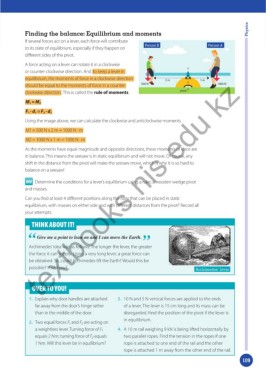
            If several forces act on a lever, each force will contribute
                                                                   Person B                     Person A
            to its state of equilibrium, especially if they happen on
            different sides of the pivot.

            A force acting on a lever can rotate it in a clockwise
            or counter-clockwise direction. And  to keep a lever in
                   textbooks nis edu kz
            equilibrium, the moments of force in a clockwise direction       2 m             1 m
            should be equal to the moments of force in a counter-  500 N                             1000 N
            clockwise direction . This is called the rule of moments.               pivot
             M 1  = M 2

             F 1  ∙ d 1  = F 2  ∙ d 2

            Using the image above, we can calculate the clockwise and anticlockwise moments.
             M1 = 500 N x 2 m = 1000 N · m

             M2 = 1000 N x 1 m = 1000 N · m

            As the moments have equal magnitude and opposite directions, these moments of force are
            in balance. This means the seesaw is in static equilibrium and will not move. Of course, any
            shift in the distance from the pivot will make the seesaw move, which is why it is so hard to
            balance on a seesaw!

             INV  Determine the conditions for a lever’s equilibrium using a ruler, a wooden wedge pivot
            and masses.

            Can you find at least 4 different positions along the ruler that can be placed in static
            equilibrium, with masses on either side and with different distances from the pivot? Record all
            your attempts.

               THINK ABOUT IT!


                  Give me a point to lean on and I can move the Earth.

              Archimedes’ idea was as follows: The longer the lever, the greater
              the force it can supply. Using a very long lever, a great force can
              be obtained. So, could Archimedes lift the Earth? Would this be
              possible? If so, how?                                                        Archimedes’ lever


                OVER TO YOU!


              1.  Explain why door handles are attached   3.  10 N and 5 N vertical forces are applied to the ends
                 far away from the door’s hinge rather    of a lever. The lever is 15 cm long and its mass can be
                 than in the middle of the door.          disregarded. Find the position of the pivot if the lever is
                                                          in equilibrium.
              2.  Two equal forces F₁ and F₂ are acting on
                 a weightless lever. Turning force of F₁   4.  A 10 m rail weighing 9 kN is being lifted horizontally by
                 equals 2 Nm; turning force of F₂ equals   two parallel ropes. Find the tension in the ropes if one
                 1 Nm. Will this lever be in equilibrium?  rope is attached to one end of the rail and the other
                                                          rope is attached 1 m away from the other end of the rail.
                                                                                                                109

