


Page 110 -
P. 110
11.3   Simple machines


                 Why do you think the           Mechanical advantage
                 Ancient Egyptians used         Simple machines are machines that do not need an internal source
                 ramps to help them             of energy. To make them work, an external force needs to be exerted.

                 carry stones to the top        Some of these machines are able to multiply the input force, at the
                   textbooks nis edu kz
                 of the pyramids?               expense of distance, to perform the work to be done. Simple machines
                                                work with some combination of four basic principles:
                                                1.  increasing the magnitude of a force

                                                2.  increasing the distance or speed of a force on which it is acting

                                                3.  transferring a force from one place to another
                                                4.  changing the direction of a force

                                                But remember, energy cannot be created or destroyed. This means
                                                that the overall work done does not change. So a small force is able to
                                                perform amazing feats of strength! The downside is that this force will
                                                need to be applied for a much longer distance. This is the exchange
                                                involved in simple machines everywhere: you swap a large force over a
                                                small distance for a small force over a large distance.

                                                This trade-off is what is known as the ‘golden rule of mechanics’:  what is
                                                lost in force is gained in displacement, and what is gained in force is lost
                                                in displacement . We tend to use ramps, pulleys and other machines to
                                                lift things that would otherwise be too heavy for our own muscles. As
                                                we will see below, a smaller force achieves the necessary work, but over
                                                a greater distance. These simple machines are designed to change the
                                                transfer of energy from the work done due to the force exerted into
                                                work done that requires a smaller force to perform the same task.


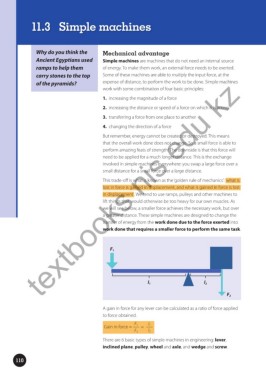
                                                   F 1


                                                                     l 1                       l 2

                                                                                                         F 2


                                                A gain in force for any lever can be calculated as a ratio of force applied
                                                to force obtained.

                                                 Gain in force =   F 1  =  l 1
                                                               F 2   l 2
                                                There are 6 basic types of simple machines in engineering: lever,
                                                inclined plane, pulley, wheel and axle, and wedge and screw.

        110

