


Page 107 -
P. 107
Physics
            Types of equilibrium

            When an object is not moving we say it is in static equilibrium. This equilibrium depends
            on the relationship between the point of support on a surface, the point of support on the
            object and the centre of mass (i.e. the pivot).

            The lower the centre of gravity, the more stable the equilibrium. For example, low-slung
            cars have the lowest risk of rollover. Or think of a tightrope walker who uses a long rod
                   textbooks nis edu kz
            that bends to the level of the rope. This means that the tightrope walker’s centre of gravity
            moves lower, making it easier to walk safely because the system becomes more stable. But
            this only happens when the centre of mass is below the pivot, or the balancing point. Any
            deviation from the pivot will cause an object to become unstable and rotate.

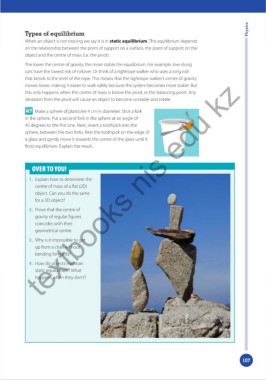
             ACT  Make a sphere of plasticine 4 cm in diameter. Stick a fork
            in the sphere. Put a second fork in the sphere at an angle of
            45 degrees to the first one. Next, insert a toothpick into the
            sphere, between the two forks. Rest the toothpick on the edge of
            a glass and gently move it towards the centre of the glass until it
            finds equilibrium. Explain the result.


                OVER TO YOU!

              1.  Explain how to determine the
                 centre of mass of a flat (2D)
                 object. Can you do the same
                 for a 3D object?

              2.  Prove that the centre of
                 gravity of regular figures
                 coincides with their
                 geometrical centre.

              3.  Why is it impossible to get
                 up from a chair without
                 bending forwards?

              4.  How do objects maintain
                 static equilibrium? What
                 happens when they don’t?


                                                                                                                107

