


Page 28 -
P. 28
3.2   Accelerate!


                 A plane takes off at           Changes in velocity
                 Atyrau and flies to            In Unit 2 we learnt about how an object can change its velocity (speed)
                 Oskemen. What is               over time. We called it speeding up or slowing down. But in Physics we

                 the difference in the          should talk about this change of velocity (speed) in a different way.
                   textbooks nis edu kz
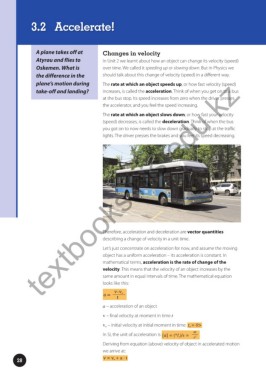
                 plane’s motion during          The rate at which an object speeds up, or how fast velocity (speed)
                 take-off and landing?          increases, is called the acceleration. Think of when you get on to a bus
                                                at the bus stop. Its speed increases from zero when the driver presses
                                                the accelerator, and you feel the speed increasing.

                                                The rate at which an object slows down, or how fast your velocity
                                                (speed) decreases, is called the deceleration. Think of when the bus
                                                you got on to now needs to slow down gradually to stop at the traffic
                                                lights. The driver presses the brakes and you feel its speed decreasing.


                                                Therefore, acceleration and deceleration are vector quantities
                                                describing a change of velocity in a unit time.
                                                Let’s just concentrate on acceleration for now, and assume the moving
                                                object has a uniform acceleration – its acceleration is constant. In
                                                mathematical terms, acceleration is the rate of change of the
                                                velocity. This means that the velocity of an object increases by the
                                                same amount in equal intervals of time. The mathematical equation
                                                looks like this:


                                                     v–v o
                                                   =
                                                       t
                                                a – acceleration of an object

                                                v – final velocity at moment in time t
                                                v o  – initial velocity at initial moment in time:  t o  = 0>
                                                                                          m
                                                                                 m
                                                In SI, the unit of acceleration is  [   ] = ( / s )/s =
                                                                                          s 2
                                                Deriving from equation (above) velocity of object in accelerated motion
                                                we arrive at:
         28                                      v = v o  + a ∙ t

