


Page 31 -
P. 31
Physics
            Calculating distance travelled from a
            velocity–time graph                                                 v

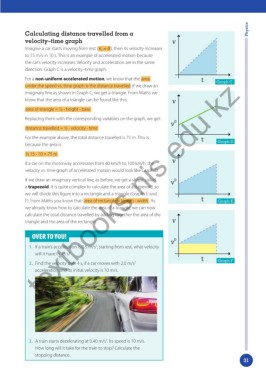
            Imagine a car starts moving from rest ( v o  = 0 ), then its velocity increases
            to 15 m/s in 10 s. This is an example of accelerated motion because
            the car’s velocity increases. Velocity and acceleration are in the same
            direction. Graph C is a velocity–time graph.

            For a non-uniform accelerated motion, we know that the  area                     t      Graph C
            under the speed vs. time graph is the distance travelled. If we draw an
            imaginary line as shown in Graph C, we get a triangle. From Maths we
            know that the area of a triangle can be found like this:
                                                                                v
             area of triangle = ½ ∙ height ∙ base

            Replacing them with the corresponding variables on the graph, we get: vedu kz
                                                                                 0
                                                                               v
             distance travelled = ½ ∙ velocity ∙ time
            For the example above, the total distance travelled is 75 m. This is
                                                                                             t       Graph D
                   textbooks nis
            because the area is
             ½ 15 ∙ 10 = 75 m

            If a car on the motorway accelerates from 40 km/h to 100 km/h, the
            velocity vs. time graph of accelerated motion would look like Graph D.

            If we draw an imaginary vertical line, as before, we get a shape called   0
                                                                               v
            a trapezoid. It is quite complex to calculate the area of a trapezoid, so
            we will divide this figure into a rectangle and a triangle (Graphs E and
            F). From Maths you know that:  area of rectangle = length ∙ width . As           t       Graph E
            we already know how to calculate the area of a triangle, we can now
            calculate the total distance travelled by adding together the area of the
            triangle and the area of the rectangle.                             v

                OVER TO YOU!

                                                                               v 0
              1.  If a train’s acceleration is 0.5 m/s , starting from rest, what velocity
                                             2
                 will it have in 15 s?
                                                                                             t       Graph F
                                                               2
              2.  Find the velocity over 4 s, if a car moves with 2.0 m/s
                 acceleration and its initial velocity is 10 m/s.


              3.  A train starts decelerating at 0.40 m/s . Its speed is 10 m/s.
                                                  2
                 How long will it take for the train to stop? Calculate the
                 stopping distance.
                                                                                                                 31

