


Page 26 -
P. 26
3.1    Speeding up and slowing down:


                          Non-uniform motion


                 Imagine you are                What happens when an object changes its speed?
                 sledging down a hill …         When an object changes its speed, it can either increase it (speed up) or

                 and then going down            decrease it (slow down). This means that the initial speed of the object is
                   textbooks nis edu kz
                 an escalator in the            different from its final speed. The motion is no longer uniform because
                 underground. How are           the speed is no longer constant. When we have different speeds for a
                                                moving object, we are able to calculate the average speed.
                 these types of motion
                 different?                      average speed (m/s) =  total distance travelled (m) / total time elapsed (s)
                                                Also, if we know the initial speed and the final speed of the object, we
                                                can calculate the average speed as:

                                                v average = (v final + v initial) / 2

                                                ACT  Consider the motion of a car. It covers distance d  at a speed of
                                                                                               1
                                                60 km/h, distance d  at 75 km/h, and distance d  at 65 km/h. What is the
                                                                 2                        3
                                                car’s average speed?


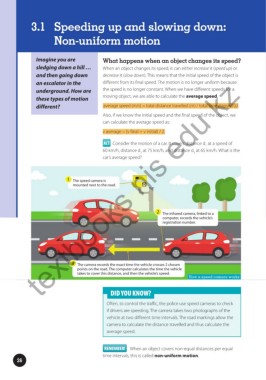
                                1  The speed camera is
                                  mounted next to the road.


                                                                         2  The infrared camera, linked to a
                                                                            computer, records the vehicle’s
                                                                            registration number.


                                  3  The camera records the exact time the vehicle crosses 2 chosen
                                    points on the road. The computer calculates the time the vehicle
                                    takes to cover this distance, and then the vehicle’s speed.
                                                                                        How a speed camera works


                                                    DID YOU KNOW?

                                                  Often, to control the traffic, the police use speed cameras to check
                                                  if drivers are speeding. The camera takes two photographs of the
                                                  vehicle at two different time intervals. The road markings allow the
                                                  camera to calculate the distance travelled and thus calculate the
                                                  average speed.


                                                 REMEMBER!    When an object covers non-equal distances per equal
                                                time intervals, this is called non-uniform motion.
         26

