


Page 38 -
P. 38
4.2   Volume of objects


                 Different types of             Volume of solid, liquid and gas
                 food come in lots of           The physical quantity that determines
                 different shapes and           how much space an object occupies

                 sizes. How could we            is called the volume of the body. In
                   textbooks nis edu kz
                 measure the volume             Maths you have learnt how to calculate                       height
                                                volumes of regular solids (e.g. cubes)
                 of some potatoes                                                     depth
                                                using the following equation:
                 and carrots? Why is it
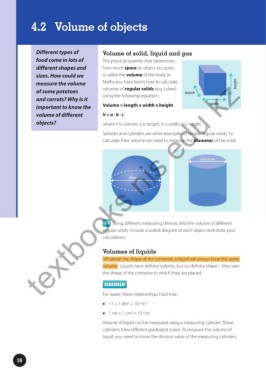
                 important to know the          Volume = length x width x height                 width
                 volume of different            V = a · b · c
                 objects?                       where V is volume, a is length, b is width, c is height.

                                                Spheres and cylinders are other examples of simple regular solids. To
                                                calculate their volume we need to measure the diameter of the solid.


                                                                                             diameter


                                                            diameter


                                                INV   Using different measuring devices, find the volume of different
                                                regular solids. Include a scaled diagram of each object and show your
                                                calculations.


                                                Volumes of liquids
                                                 Whatever the shape of the container, a liquid will always have the same
                                                volume . Liquids have definite volume, but no definite shape – they take
                                                the shape of the container in which they are placed.


                                                 REMEMBER!

                                                For water, these relationships hold true:
                                                            3
                                                ●  1 l = 1 dm = 10 m 3
                                                                 -3
                                                ●  1 ml = 1 cm = 10 m 3
                                                             3
                                                                  -6
                                                Volume of liquid can be measured using a measuring cylinder. These
                                                cylinders have different graduated scales. To measure the volume of
                                                liquid, you need to know the division value of the measuring cylinders.


         38

