


Page 36 -
P. 36
4.1   Object mass


                 Why is it easier to            All objects in nature, large and small – the Sun, the Earth, a human
                 move an apple than a           being, a water droplet, a grain of sand – have an intrinsic property
                 watermelon? Why is             called mass. Simply put, mass can be said to be a measurement of

                 it sometimes difficult         the amount of matter that makes up a particular object. As you have
                   textbooks nis edu kz
                                                learnt in Chemistry, objects (physical bodies) are made up of lots of
                 to make objects move
                                                atoms and other smaller particles.
                 and even harder to
                 stop them moving?              Mass is denoted by the letter m. The SI unit of mass is the kilogram (kg).
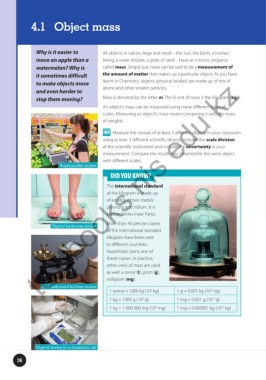
                                                An object’s mass can be measured using many different types of
                                                scales. Measuring an object’s mass means comparing it with the mass
                                                of weights.

                                                INV   Measure the masses of at least 5 different objects in your classroom
                                                using at least 3 different scientific devices. Include the scale division
                                                of the scientific instrument and include the uncertainty in your
                                                measurement. Compare the results you obtained for the same object
                                                with different scales.
                            Supermarket scales
                                                    DID YOU KNOW?

                                                  The international standard
                                                  of the kilogram is made up
                                                  of an alloy of two metals:
                                                  platinum and iridium. It is
                                                  kept in Sèvres (near Paris).

                                                  More than 40 precise copies
                         Digital bathroom scales
                                                  of the international standard
                                                  kilogram have been sent
                                                  to different countries.
                                                  Kazakhstan owns one of
                                                  these copies. In practice,
                                                  other units of mass are used
                                                  as well: a tonne (t), gram (g),
                                                  milligram (mg).
                    Old-fashioned kitchen scales
                                                   1 tonne = 1000 kg (10  kg)     1 g = 0.001 kg (10  kg)
                                                                      3
                                                                                                  -3
                                                                  3
                                                                                                  -3
                                                   1 kg = 1000 g (10  g)          1 mg = 0.001 g (10  g)
                                                                                                       -6
                                                                        6
                                                   1 kg = 1 000 000 mg (10  mg)   1 mg = 0.000001 kg (10  kg)


                  Digital scales in a chemistry lab

         36

