


Page 11 -
P. 11
Physics
            Calculating with vectors

            Vector quantities are physical quantities that have
            a specific direction associated with their value.
            Mathematical operations on vector quantities differ from
            operations with scalar quantities, because it is always   1               2                  3
            necessary to consider the effects of their direction on a
            body. These physical quantities are usually linked with
                   textbooks nis edu kz
            movement and forces.

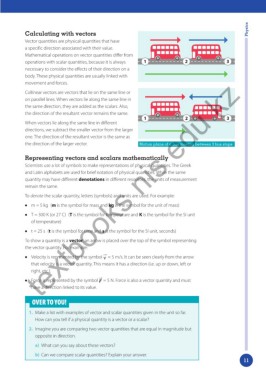
            Collinear vectors are vectors that lie on the same line or
            on parallel lines. When vectors lie along the same line in
            the same direction, they are added as the scalars. Also,
            the direction of the resultant vector remains the same.
                                                                   1                  2                  3
            When vectors lie along the same line in different
            directions, we subtract the smaller vector from the larger
            one. The direction of the resultant vector is the same as
            the direction of the larger vector.                  Motion plans of a bus moving between 3 bus stops


            Representing vectors and scalars mathematically
            Scientists use a lot of symbols to make representations of physical quantities. The Greek
            and Latin alphabets are used for brief notation of physical quantities. While the same
            quantity may have different denotations in different resources, the units of measurement
            remain the same.

            To denote the scalar quantity, letters (symbols) and units are used. For example:

            ●  m = 5 kg  (m is the symbol for mass and kg is the symbol for the unit of mass)

            ●  T = 300 K (or 27 C)  (T is the symbol for temperature and K is the symbol for the SI unit
               of temperature)
            ●  t = 25 s  (t is the symbol for time and s is the symbol for the SI unit, seconds)

            To show a quantity is a vector, an arrow is placed over the top of the symbol representing
            the vector quantity. For example:

            ●  Velocity is represented by the symbol   = 5 m/s. It can be seen clearly from the arrow
                                                v
               that velocity is a vector quantity. This means it has a direction (i.e. up or down, left or
               right, etc.).

            ●  Force is represented by the symbol    = 5 N. Force is also a vector quantity and must
               have a direction linked to its value.

                OVER TO YOU!


              1.  Make a list with examples of vector and scalar quantities given in the unit so far.
                 How can you tell if a physical quantity is a vector or a scalar?

              2.  Imagine you are comparing two vector quantities that are equal in magnitude but
                 opposite in direction.
                 a)  What can you say about these vectors?

                 b)  Can we compare scalar quantities? Explain your answer.
                                                                                                                 11

