


Page 14 -
P. 14
Unit summary


               Revise!

               1.  A unit of measurement of length that is still   6.  Imagine you go on an expedition with your class.
                  sometimes used in the United Kingdom is called    Look at the map your teacher gives you. You have
                  a yard. 1 yard equals 91.44 cm. Express this      to travel 2 km to the north and 1.5 km to the east.
                   textbooks nis edu kz
                  length in metres. Another unit of length used     You are responsible for ensuring that your team
                  is the mile. 1 mile has 1760 yards. How many      does not stray off course, so you must draw a
                  metres are there in a mile?                       map of the route. Draw a scaled scheme of your
                                                                    route, where 1 cm on the scheme stands for
               2.  Compare the physical quantities of mass and
                  temperature. How are they similar, and how are    1 km distance.
                  they different? Explain your answer in detail.    a)  Draw a line joining the starting point of
                                                                       the motion and the finishing point. Which
               3.  Separate these words into substances and
                                                                       quantity – vector or scalar – does this line
                  physical bodies:
                                                                       refer to? Give a reasoned answer.
                  a)  rose        e)  snow        i)  pencil
                                                                    b)  How many km did you travel during
                  b)  steel       f)  alcohol     j)  copper           the expedition?
                  c)  sleepers    g)  dew drop    k)  fork       7.  The weather we experience is a collection of

                  d)  house       h)  water                         different physical phenomena. Create a weather
                                                                    forecast leaflet for your town. It needs to explain
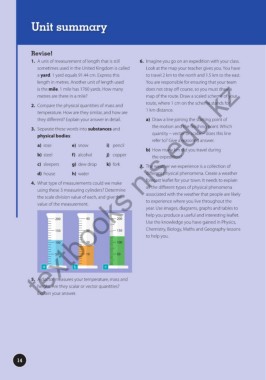
               4.  What type of measurements could we make
                  using these 3 measuring cylinders? Determine      all the different types of physical phenomena
                  the scale division value of each, and give the    associated with the weather that people are likely
                  value of the measurement.                         to experience where you live throughout the
                                                                    year. Use images, diagrams, graphs and tables to
                                                                    help you produce a useful and interesting leaflet.
                          200           40             200
                                                                    Use the knowledge you have gained in Physics,

                          150           30             150          Chemistry, Biology, Maths and Geography lessons
                                                                    to help you.
                          100           20             100

                          50            10             50


                     a             b             c

               5.  A doctor measures your temperature, mass and
                  height. Are they scalar or vector quantities?
                  Explain your answer.


         14

