


Page 16 -
P. 16
2.1    How do we know how far we have


                          moved? Distance and displacement


                 To get to school, you          Describing movement
                 need to travel there           When we are moving from one place to another, we always travel a

                 from home taking               specific distance. The distance an object travels along a trajectory (or
                   textbooks nis edu kz
                 the shortest possible          path) is called the distance covered or simply distance. It is denoted
                 route. You could walk          by the letter d and measured in metres (m). The distance covered
                                                depends on the trajectory we take to reach a specific location.
                 or take a bus. You
                 could choose a taxi,           But it is also important to know the direction of movement. When
                 or even a helicopter!          an object moves, we can take note of its initial position and its final
                                                position. The numerical difference between the straight line that links
                 What do you think are
                                                the final and the initial position is called the total displacement or
                 the similarities and
                                                simply displacement.
                 differences between
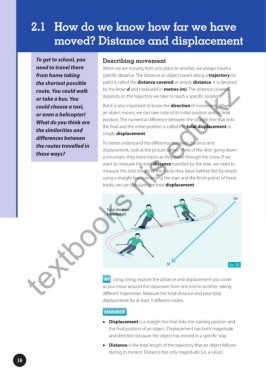
                                                To better understand the difference between distance and
                 the routes travelled in
                                                displacement, look at the picture below. Think of the skier going down
                 these ways?
                                                a mountain; they leave tracks as they travel through the snow. If we
                                                want to measure the total distance travelled by the skier, we need to
                                                measure the total length of the tracks they leave behind. But by simply
                                                using a straight line connecting the start and the finish points of these
                                                tracks, we can calculate the total displacement.


                                                                                                            So

                                                  Total distance
                                                  travelled (d)


                                                                             Sf                           So–Sf


                                                INV   Using string, explore the distance and displacement you cover
                                                as you move around the classroom from one end to another, taking
                                                different trajectories. Measure the total distance and your total
                                                displacement for at least 3 different routes.


                                                 REMEMBER!
                                                ●  Displacement is a straight line that links the starting position and
                                                   the final position of an object. Displacement has both magnitude
                                                   and direction because the object has moved in a specific way.

                                                ●  Distance is the total length of the trajectory that an object follows
                                                   during its motion. Distance has only magnitude (i.e. a value).
         16

