


Page 122 -
P. 122
Unit summary


               Check your knowledge and understanding

               1.  Describe and explain what you understand by   6.  Name and explain two different types of motion
                  the term Solar System.                            the Earth has. How are these reflected in our
                                                                    calendars?
                   textbooks nis edu kz
               2.  How do the planets of the Solar System compare
                  with each other?                               7.  Explain what high and low tides are. What
                                                                    celestial bodies affect the tides? Can we observe
               3.  What is a natural satellite?
                                                                    the phenomenon of high and low tide in the
               4.  Why does the Moon go through different phases?   central regions of Kazakhstan? How could you try
                  Explain your answer in detail.                    to find out?

               5.  Re-write the following statements to ensure they
                  are scientifically correct. Use the key words from
                  the unit.
                  a)  The Sun moves across the sky and goes from
                     east to west.

                  b)  The Moon does not orbit the Sun.

                  c)  The seasons are always the same wherever we
                     go on Earth.


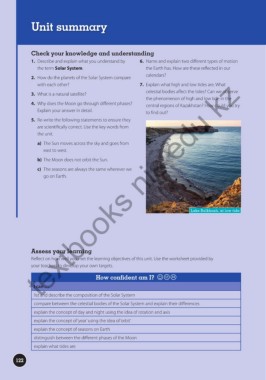
                                                                                        Lake Balkhash, at low tide


               Assess your learning
               Reflect on how well you met the learning objectives of this unit. Use the worksheet provided by
               your teachers to develop your own targets.

                                             How confident am I?

                I can …

                list and describe the composition of the Solar System
                compare between the celestial bodies of the Solar System and explain their differences

                explain the concept of day and night using the idea of rotation and axis
                explain the concept of ‘year’ using the idea of ‘orbit’

                explain the concept of seasons on Earth
                distinguish between the different phases of the Moon
                explain what tides are


        122

