


Page 119 -
P. 119
Physics

            From our observations of the stars we know that their patterns in the sky repeat over a
            period of time. The same thing happens with the seasons. This has helped us to conclude
            that the Earth goes through a cycle. We call this a year. One year is the time it takes for the
            Earth to orbit once around the Sun.
            We also know that this path is not a perfect circle. It is an ellipse, and although the
            intensity of sunlight changes because the distance from the Sun changes, this is not the
                   textbooks nis edu kz
            cause of the seasons. The different hemispheres still experience different and opposing
            seasons throughout the year. The change of seasons must be caused by something else.

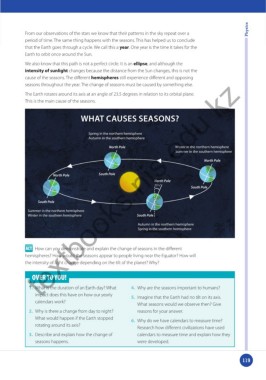
            The Earth rotates around its axis at an angle of 23.5 degrees in relation to its orbital plane.
            This is the main cause of the seasons.


                                      WHAT CAUSES SEASONS?


                                          Spring in the northern hemisphere
                                          Autumn in the southern hemisphere

                                                   North Pole                    Winter in the northern hemisphere
                                                                                 Summer in the southern hemisphere
                                                                                               North Pole


                         North Pole           South Pole
                                                                        North Pole
                                                                        23 /2°
                                                                         1
                                                                                         South Pole

                  South Pole

              Summer in the northern hemisphere
              Winter in the southern hemisphere                 South Pole

                                                                Autumn in the northern hemisphere
                                                                Spring in the southern hemisphere


             ACT  How can you demonstrate and explain the change of seasons in the different
            hemispheres? How would the seasons appear to people living near the Equator? How will
            the intensity of light change depending on the tilt of the planet? Why?


                OVER TO YOU!


              1.  What is the duration of an Earth day? What   4.  Why are the seasons important to humans?
                 impact does this have on how our yearly     5.  Imagine that the Earth had no tilt on its axis.
                 calendars work?
                                                                What seasons would we observe then? Give
              2.  Why is there a change from day to night?      reasons for your answer.
                 What would happen if the Earth stopped
                                                             6.  Why do we have calendars to measure time?
                 rotating around its axis?
                                                                Research how different civilizations have used
              3.  Describe and explain how the change of        calendars to measure time and explain how they
                 seasons happens.                               were developed.


                                                                                                                119

