


Page 117 -
P. 117
Physics
            Differences between the planets

            There are two main types of planet in our Solar
            System, those in the inner belt and those in the
            outer belt. Planets in the inner belt are: Mercury,
            Venus, Earth and Mars. These planets have a solid
            rocky surface and are much smaller than the outer
            belt planets (Jupiter, Saturn, Uranus and Neptune).
                   textbooks nis edu kz

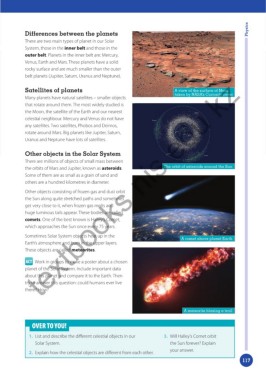
            Satellites of planets                                                A view of the surface of Mars,
                                                                                 taken by NASA’s Curiosity rover
            Many planets have natural satellites – smaller objects
            that rotate around them. The most widely studied is
            the Moon, the satellite of the Earth and our nearest
            celestial neighbour. Mercury and Venus do not have
            any satellites. Two satellites, Phobos and Deimos,
            rotate around Mars. Big planets like Jupiter, Saturn,
            Uranus and Neptune have lots of satellites.


            Other objects in the Solar System
            There are millions of objects of small mass between
            the orbits of Mars and Jupiter, known as asteroids.             The orbit of asteroids around the Sun
            Some of them are as small as a grain of sand and
            others are a hundred kilometres in diameter.

            Other objects consisting of frozen gas and dust orbit
            the Sun along quite stretched paths and sometimes
            get very close to it, when frozen gas melts and
            huge luminous tails appear. These bodies are called
            comets. One of the best known is Halley’s Comet,
            which approaches the Sun once every 75 years.

            Sometimes Solar System objects heat up in the
                                                                                    A comet above planet Earth
            Earth’s atmosphere and burn in the upper layers.
            These objects are called meteorites.

             ACT  Work in groups to make a poster about a chosen
            planet of the Solar System. Include important data
            about this planet and compare it to the Earth. Then
            try to answer this question: could humans ever live
            there? How?


                                                                                     A meteorite blazing a trail


                OVER TO YOU!


              1.  List and describe the different celestial objects in our   3.  Will Halley’s Comet orbit
                 Solar System.                                                 the Sun forever? Explain
                                                                               your answer.
              2.  Explain how the celestial objects are different from each other.
                                                                                                                117

