


Page 118 -
P. 118
12.2   Does the Earth move?


                 If you look up to the          The Earth has been in existence
                 sky at different times         for around 4.6 billion years, and
                 of the day you will see        the way it moves around the

                 that the Sun appears           Sun has influenced how life on
                   textbooks nis edu kz
                                                Earth has evolved. Initially, there
                 to move from east to
                                                were two possible explanations
                 west across the sky.
                                                about the movement of planets:
                 The stars in the night
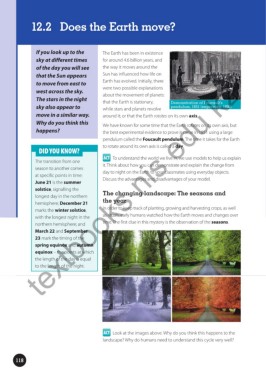
                                                that the Earth is stationary,   Demonstration of Foucault’s
                 sky also appear to             while stars and planets revolve   pendulum, 1851 (engraving, 1890)
                 move in a similar way.         around it; or that the Earth rotates on its own axis.
                 Why do you think this          We have known for some time that the Earth rotates on its own axis, but
                 happens?                       the best experimental evidence to prove it came in 1851 using a large

                                                pendulum called the Foucault pendulum. The time it takes for the Earth
                                                to rotate around its own axis is called a day.
                   DID YOU KNOW?
                                                ACT  To understand the world we live in, we use models to help us explain
                 The transition from one
                                                it. Think about how you can demonstrate and explain the change from
                 season to another comes
                                                day to night on the Earth to your classmates using everyday objects.
                 at specific points in time:
                                                Discuss the advantages and disadvantages of your model.
                 June 21 is the summer
                 solstice, signalling the       The changing landscape: The seasons and
                 longest day in the northern
                 hemisphere; December 21        the year
                 marks the winter solstice,     In order to keep track of planting, growing and harvesting crops, as well
                 with the longest night in the   as rituals, early humans watched how the Earth moves and changes over
                 northern hemisphere; and       time. The first clue in this mystery is the observation of the seasons.
                 March 22 and September
                 23 mark the timing of the
                 spring equinox and autumn
                 equinox – the points at which
                 the length of the day is equal
                 to the length of the night.


                                                ACT  Look at the images above. Why do you think this happens to the
                                                landscape? Why do humans need to understand this cycle very well?


        118

