


Page 121 -
P. 121
Physics
            Eclipses

            Lunar eclipses and solar eclipses are very
            important natural phenomena that have caused
            awe, wonder and fear throughout human history. In
            prehistoric times, solar and lunar eclipses frightened
            people and they were usually associated with
            different catastrophic events.
                   textbooks nis edu kz
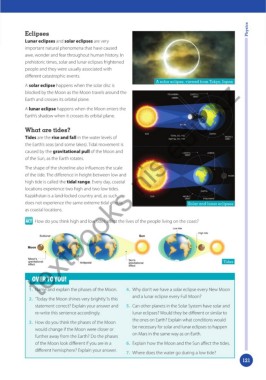
                                                                         A solar eclipse, viewed from Tokyo, Japan
            A solar eclipse happens when the solar disc is
            blocked by the Moon as the Moon travels around the
            Earth and crosses its orbital plane.
            A lunar eclipse happens when the Moon enters the
            Earth’s shadow when it crosses its orbital plane.


            What are tides?
            Tides are the rise and fall in the water levels of
            the Earth’s seas (and some lakes). Tidal movement is
            caused by the gravitational pull of the Moon and
            of the Sun, as the Earth rotates.

            The shape of the shoreline also influences the scale
            of the tide. The difference in height between low and
            high tide is called the tidal range. Every day, coastal
            locations experience two high and two low tides.
            Kazakhstan is a land-locked country and, as such,
            does not experience the same extreme tidal effects                         Solar and lunar eclipses
            as coastal locations.


             ACT  How do you think high and low tides affect the lives of the people living on the coast?


                                                                                                       Tides


                OVER TO YOU!

              1.  Name and explain the phases of the Moon.  4.  Why don’t we have a solar eclipse every New Moon
                                                              and a lunar eclipse every Full Moon?
              2.  ‘Today the Moon shines very brightly.’ Is this
                 statement correct? Explain your answer and   5.  Can other planets in the Solar System have solar and
                 re-write this sentence accordingly.          lunar eclipses? Would they be different or similar to
                                                              the ones on Earth? Explain what conditions would
              3.  How do you think the phases of the Moon
                                                              be necessary for solar and lunar eclipses to happen
                 would change if the Moon were closer or
                                                              on Mars in the same way as on Earth.
                 further away from the Earth? Do the phases
                 of the Moon look different if you are in a   6.  Explain how the Moon and the Sun affect the tides.
                 different hemisphere? Explain your answer.
                                                           7.  Where does the water go during a low tide?
                                                                                                                121

