


Page 116 -
P. 116
12.1   The Solar System


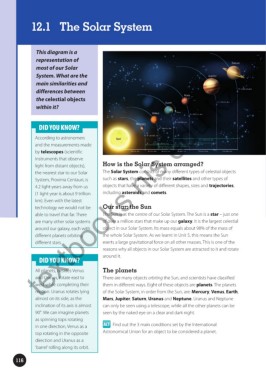
                 This diagram is a
                 representation of
                 most of our Solar

                 System. What are the
                   textbooks nis edu kz
                 main similarities and
                 differences between

                 the celestial objects
                 within it?


                   DID YOU KNOW?


                 According to astronomers
                 and the measurements made
                 by telescopes (scientific
                 instruments that observe
                 light from distant objects),   How is the Solar System arranged?
                 the nearest star to our Solar   The Solar System consists of many different types of celestial objects
                 System, Proxima Centauri, is   such as stars, the planets and their satellites and other types of
                 4.2 light-years away from us   objects that have a variety of different shapes, sizes and trajectories,
                 (1 light-year is about 9 trillion   including asteroids and comets.
                 km). Even with the latest
                 technology we would not be     Our star: the Sun
                 able to travel that far. There   The Sun is at the centre of our Solar System. The Sun is a star – just one
                 are many other solar systems   of over a million stars that make up our galaxy. It is the largest celestial
                 around our galaxy, each with   object in our Solar System. Its mass equals about 98% of the mass of
                 different planets orbiting     the whole Solar System. As we learnt in Unit 5, this means the Sun
                 different stars.               exerts a large gravitational force on all other masses. This is one of the
                                                reasons why all objects in our Solar System are attracted to it and rotate
                                                around it.
                   DID YOU KNOW?


                 All planets, besides Venus     The planets
                 and Uranus, rotate east to     There are many objects orbiting the Sun, and scientists have classified
                 west while completing their    them in different ways. Eight of these objects are planets. The planets
                 motion. Uranus rotates lying   of the Solar System, in order from the Sun, are: Mercury, Venus, Earth,
                 almost on its side, as the     Mars, Jupiter, Saturn, Uranus and Neptune. Uranus and Neptune
                 inclination of its axis is almost   can only be seen using a telescope, while all the other planets can be
                 90°. We can imagine planets    seen by the naked eye on a clear and dark night.
                 as spinning tops rotating
                 in one direction, Venus as a   ACT  Find out the 3 main conditions set by the International
                 top rotating in the opposite   Astronomical Union for an object to be considered a planet.
                 direction and Uranus as a
                 ‘barrel’ rolling along its orbit.

        116

