


Page 17 -
P. 17
Physics
            Relative motion

            In daily life we often come across movement called
            mechanical motion. This is the change of position
            of a moving object relative to other objects. Every
            type of motion is relative depending on your
            reference point, particularly whether the object
            is stationary (at rest) or moving. This is called the
                   textbooks nis edu kz
            system of reference. The total observed distance
            covered by an object depends on its trajectory but
            also the observer’s point of reference.

            Imagine you are standing on a platform waiting for a
            train, playing with a tennis ball. You are throwing the
            ball up and catching it when it drops back down. You
            then look up at a passing train and another person
            inside the train is doing the same thing. But as you
            are standing outside the train, it looks like the ball has
            moved in a big curve. Motion and the trajectory are
            dependent on the observer!

                OVER TO YOU!


              1.  Draw a trajectory of the motion of the Earth relative to the Sun. Calculate the
                 distance covered by the Earth moving around the Sun.

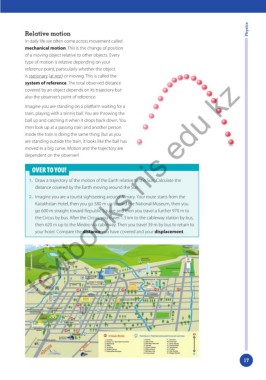
              2.  Imagine you are a tourist sightseeing around Almaty. Your route starts from the
                 Kazakhstan Hotel, then you go 580 m up toward the National Museum, then you
                 go 600 m straight toward Republic Square and then you travel a further 970 m to
                 the Circus by bus. After the Circus, you travel 1.3 km to the cableway station by bus,
                 then 620 m up to the Medeo via cableway. Then you travel 39 m by bus to return to
                 your hotel. Compare the distance you have covered and your displacement.


                                                                                                                 17

