


Page 18 -
P. 18
2.2    Moving at a constant speed:


                          Uniform motion


                 Suggest a method for           When do objects move uniformly?
                 determining whether            If an object travels equal distances within equal periods of time this

                 a car is moving                motion is called uniform. For example, when a moving object leaves
                   textbooks nis edu kz
                 uniformly while you            some kind of a trace behind as it is travelling (such as a car dripping oil),
                 are sitting in the back        and we observe that the distance between the traces is equal, we can
                                                infer that this object is moving uniformly. That means it is travelling with
                 seat and looking out of
                                                a constant velocity.
                 the window.
                                                What does velocity mean?

                                                Velocity is a physical quantity that describes how fast an object is
                                                moving in a specific direction. This means that velocity is a vector
                                                quantity.

                                                It is represented by symbol v. To calculate velocity (v), the total
                                                displacement (S) is divided by total time taken (t) to travel the
                                                displacement.

                                                      S
                                                 v =
                                                      t
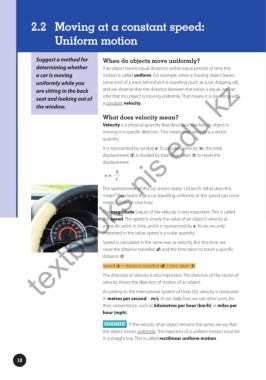
                                                The speedometer of this car shows nearly 120 km/h. What does this
                                                mean? This means that a car travelling uniformly at this speed can cover
                                                nearly 120 km in one hour.

                                                The magnitude (value) of the velocity is very important. This is called
                                                the speed. The speed is simply the value of an object’s velocity at
                                                a specific point in time, and it is represented by s. As we are only
                                                interested in the value, speed is a scalar quantity.

                                                Speed is calculated in the same way as velocity. But this time, we
                                                need the distance travelled (d) and the time taken to travel a specific
                                                distance (t):
                                                 speed (s) = distance travelled (d) / time taken (t)

                                                The direction of velocity is also important. The direction of the vector of
                                                velocity shows the direction of motion of an object.

                                                According to the International System of Units (SI), velocity is measured
                                                in metres per second – m/s. In our daily lives we use other units, for
                                                their convenience, such as kilometres per hour (km/h) or miles per
                                                hour (mph).

                                                 REMEMBER!   If the velocity of an object remains the same, we say that
                                                the object moves uniformly. The trajectory of a uniform motion must be
                                                in a straight line. This is called rectilinear uniform motion.


         18

