


Page 21 -
P. 21
Physics

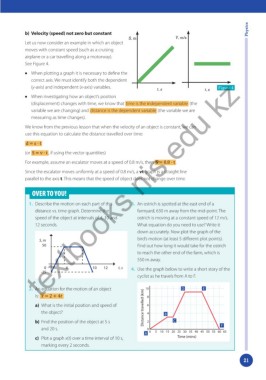
            b)  Velocity (speed) not zero but constant
                                                            S, m                  V, m/s
            Let us now consider an example in which an object
            moves with constant speed (such as a cruising
            airplane or a car travelling along a motorway).
            See Figure 4.

            ●  When plotting a graph it is necessary to define the
            For example, assume an escalator moves at a speed of 0.8 m/s, then  S = 0.8 · t .edu kz
               correct axis. We must identify both the dependent
               (y-axis) and independent (x-axis) variables.                                          Figure 4
                                                                         t, s                  t, s
            ●  When investigating how an object’s position
               (displacement) changes with time, we know that  time is the independent variable  (the
               variable we are changing) and  distance is the dependent variable  (the variable we are
               measuring as time changes).

            We know from the previous lesson that when the velocity of an object is constant, we can
            use this equation to calculate the distance travelled over time:
                 is:      = 2 + 4     textbooks nis
             d = s · t
            (or  S = v · t , if using the vector quantities)


            Since the escalator moves uniformly at a speed of 0.8 m/s, a vt graph is a straight line
            parallel to the axis t. This means that the speed of object does not change over time.


                OVER TO YOU!


              1.  Describe the motion on each part of this   3.  An ostrich is spotted at the east end of a
                 distance vs. time graph. Determine the         farmyard, 630 m away from the mid-point. The
                 speed of the object at intervals of 4, 10 and   ostrich is moving at a constant speed of 12 m/s.
                 12 seconds.                                    What equation do you need to use? Write it
                                                                down accurately. Now plot the graph of the
                                                                bird’s motion (at least 5 different plot points).
                   S, m
                    50                                          Find out how long it would take for the ostrich
                                                                to reach the other end of the farm, which is
                                                                550 m away.
                     0         4           10   12     t, s  4.  Use the graph below to write a short story of the
                    -25
                                                                cyclist as he travels from A to F.


              2.  An equation for the motion of an object                           D         E
                                                                   Distance travelled (km) 10


                 a)  What is the initial position and speed of      8 6
                    the object?                                     4       B
                 b)  Find the position of the object at 5 s         2           C
                    and 20 s.                                       0                                 F
                                                                   A  0  5 10 15 20 25 30 35 40 45 50 55 60 65
                 c)  Plot a graph x(t) over a time interval of 10 s,              Time (mins)
                    marking every 2 seconds.


                                                                                                                 21

